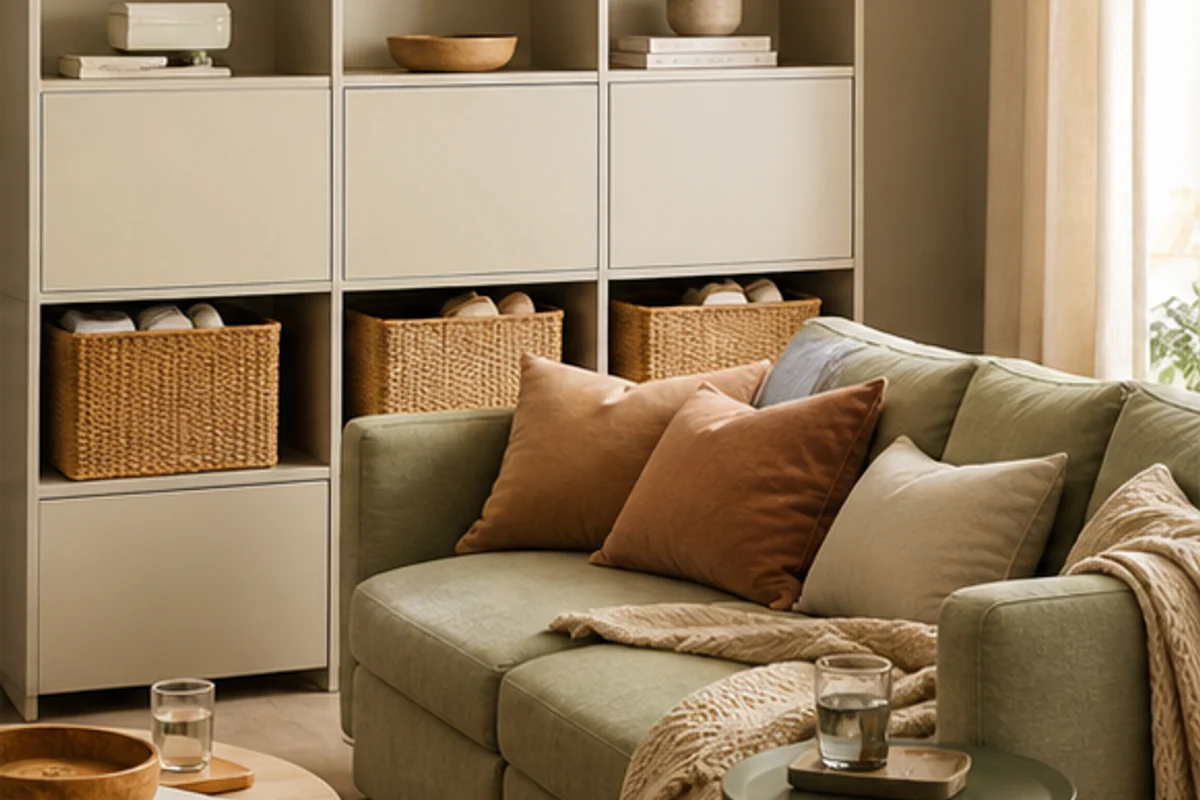
A living room often changes role several times a day. Good organisation protects comfortable circulation and quick transitions instead of giving every object a permanent display position. StorePilotia begins with the room and routine rather than a shopping list. This independent launch guide contains no paid placement and no external commercial link; it gives a reproducible method that can later support verified partner data without changing the reader-first decision.
Observe the real routine before changing the room
List the real activities, how many people perform them and which activities overlap. Draw primary seating, movement and light first, then add storage only where an item is used or reset. Photograph or sketch the current state only for private planning and avoid capturing people, addresses or sensitive household details. Note the start, the action, the reset and the point at which the routine usually fails. The best improvement often removes friction before it adds an object.
Separate a space problem from a behaviour, maintenance or capacity problem. More storage cannot solve items that have no category; a stronger appliance cannot solve an unsuitable method; an organiser cannot create a safe clearance where the room does not have one. Write one measurable outcome and one acceptable compromise.
Measure the whole fit
Record width, depth, height, door and drawer swing, circulation, sockets, vents, water, light and nearby heat where relevant. Measure at the narrowest point and include handles, hoses, cables and the body position needed to use or clean the item. A product dimension without operating clearance is incomplete.
Confirm surface, material and building constraints before drilling, heating, wetting, loading or applying a chemical. Follow authoritative product and local safety instructions. When electrical, structural, gas, water-damage or health risk is uncertain, use an appropriately qualified professional rather than improvising.
Criteria that change this home decision
Activity zones
Group each routine with its required surface, seat, light and power while allowing one area to serve more than one purpose. Keep quiet and active uses from competing where possible. Test the point in the actual room and routine, then record the measurement, observation or care requirement beside the other options. A criterion belongs in the shortlist only when it changes placement, safety, maintenance or total ownership.
Reach and frequency
Place daily controls, chargers and reading materials within comfortable reach. Move occasional items to higher, lower or more distant storage rather than filling the most useful zone. Test the point in the actual room and routine, then record the measurement, observation or care requirement beside the other options. A criterion belongs in the shortlist only when it changes placement, safety, maintenance or total ownership.
Closed and open storage
Use open storage for a small intentional set and closed storage for visual variety or dust-sensitive items. Every container needs a category and a capacity limit. Test the point in the actual room and routine, then record the measurement, observation or care requirement beside the other options. A criterion belongs in the shortlist only when it changes placement, safety, maintenance or total ownership.
Flexible furniture
Prefer pieces that can move safely, nest or serve two predictable roles without a difficult conversion. Measure the room in both normal and guest layouts. Test the point in the actual room and routine, then record the measurement, observation or care requirement beside the other options. A criterion belongs in the shortlist only when it changes placement, safety, maintenance or total ownership.
End-of-day reset
Give each shared item a return point and make the route obvious. A basket can collect temporary movement, but it still needs a scheduled emptying rule. Test the point in the actual room and routine, then record the measurement, observation or care requirement beside the other options. A criterion belongs in the shortlist only when it changes placement, safety, maintenance or total ownership.
Trial the complete routine
Simulate the normal week using existing objects or a temporary layout before buying permanent furniture or equipment. Complete the task from storage to use, clean-up and return. Include the heaviest load, busiest time and user with the most demanding reach or accessibility requirement.
Then run an awkward case: a guest, a full basket, a spill, a wet item, a lost lid, a low battery or an unavailable internet service. Finally, prove the recovery path. The room should remain understandable when one component is missing and should not require unsafe lifting, climbing or shared private credentials.
Protect safety, accessibility and privacy
Keep exits, stairs, vents, heat sources and control panels clear. Store sharp, hot, heavy or chemical items according to their instructions and household needs. Do not mix cleaning products or transfer them into food or unlabelled containers. Anchor furniture when the design, wall and local guidance require it.
Place everyday items within a comfortable range for the people who use them. Use controls that remain legible, tactile or otherwise identifiable and preserve a manual fallback for connected equipment. A home solution is not efficient when it excludes a user or moves all difficult work to another person.
Compare evidence without inventing performance
Use exact model, material, dimensions, care instructions, warranty territory and replacement-part identifiers. A merchant adjective such as premium, hygienic, eco or professional is not measurable evidence. Translate every claim into an observation: what fits, what can be cleaned, which part can be replaced and under which condition the feature operates.
For appliances, compare the intended mode, realistic noise, energy or water context, consumables and maintenance. StorePilotia does not present documentary research as laboratory testing. When calibrated measurement has not occurred, the guide states the method and limitation instead of creating a score.
Calculate total ownership and care
Add the main item, required attachments, installation, delivery, consumables, filters, energy or water, replacement wear parts and realistic cleaning time. Include the space occupied and the return path when a large object does not fit. Compare that total with a repair, rearrangement or smaller intervention.
Plan a simple review date. Materials, household size, mobility, climate and routines change. Keep instructions and part numbers in one private home record, remove account data before resale and use appropriate repair, donation or recycling routes when an item reaches the end of safe use.
Signals that require stronger proof
- Furniture blocks the main path when every seat is occupied. Stop the plan until the clearance, material, instruction or safe fallback is confirmed.
- Hidden storage has no category or capacity limit. Stop the plan until the clearance, material, instruction or safe fallback is confirmed.
- A flexible layout depends on heavy unsafe lifting. Stop the plan until the clearance, material, instruction or safe fallback is confirmed.
A risk signal is not a product verdict. It means the plan lacks a necessary fact. Ask a specific question, measure again or choose a simpler path. Do not let a discount or decorative photograph replace the evidence required for the home.
Finish with a room decision record
- State the routine and the measurable outcome.
- Keep circulation, safety and accessibility non-negotiable.
- Measure operating, cleaning and storage clearances.
- Trial the normal, awkward and recovery routes.
- Record the accepted trade-off and review date.
A mature choice is easy to explain: this arrangement supports the routine, fits these measurements, has this care path and leaves this limitation. That explanation remains useful when products, prices and households change.